Aesthetic AI is built for the encounter. Aesthetic care is not.
Intake, imaging, and scribes now handle the single encounter well. Elective aesthetic care runs across many encounters, and its data does not. Commentary on Alex Yang's session at the 2026 ASCPD Symposium.
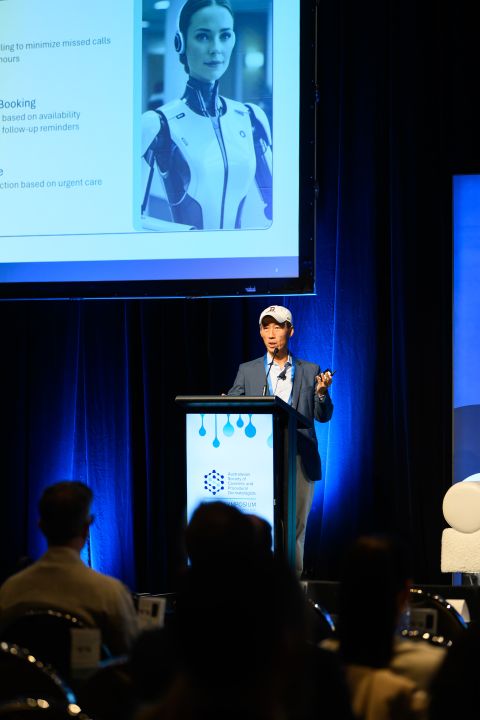
In March 2026, Alex Yang, CEO and Chair of Dr. Kudos Lab, presented "Current State of AI Technologies in Aesthetics and Its Potential Future Directions" at the Australasian Society of Cosmetic and Procedural Dermatologists (ASCPD) Symposium in Melbourne. This commentary is written for practicing clinicians. It follows the session's structure and adds our own reading of the evidence.
The thesis we take from the session is this. Most AI now sold into aesthetic practice was designed around a single event: a call, a scan, or a note. Elective aesthetic care is a relationship that runs across many such events, often over years. The binding constraint is therefore less the capability of the models than the shape of the data they are given.
Three categories, one design assumption
Intake. AI triage can route calls by urgency, books against real availability, sends reminders, and answers calls at peak and off hours so that fewer patients reach voicemail.
Computer vision. Facial scanners map skin condition and volume loss. Systems can report visible change quantitatively across visits, and augmented-reality simulation lets the clinician and patient align on an intended outcome before treatment.
Scribes. Audio transcription reduces time spent in the record and returns attention to the patient. Some tools also propose structured medical and billing codes.
Commentary. Each category works, and each was built to handle one encounter well. That is a reasonable design for episodic, disease-led care. It is a weaker fit for elective care, where the clinically useful object is the trajectory: what the patient wanted, what was done, what changed, and what they said in between.
What the scribe evidence does and does not show
Scribes are the best studied of the three. A pragmatic randomized trial of 238 outpatient physicians across 14 specialties compared two ambient scribes with usual care. One product reduced time in notes by 9.5% against control, while the other showed no significant change. Both were associated with improvements in burnout and task-load measures, which the authors describe as needing confirmation in larger trials. A single-group before-and-after study of 46 clinicians reported 20.4% less time in notes per appointment.
Commentary. The effect is real but modest, it varies by product, and it was measured in general outpatient medicine. We have not found a controlled study in aesthetic practice. Yang's point about vocabulary is plausible but, as far as we know, untested in the literature: general-purpose scribes are reported to underperform on niche aesthetic terminology, product names, and specialty-specific treatment planning, which means clinicians keep editing the note. Treat vendor claims on this point as hypotheses until you have trialed the tool on your own consultations.
Four limitations, and which are structural
- Not designed for aesthetics. Generic scribes miss aesthetic language, and much of the software was built for non-elective care.
- Capture only happens in the clinic. Patients cannot reach their own clinic data through the AI, so engagement is low and follow-up signals are fewer.
- Limited patient engagement. Imaging and consult tools help in the room but do little once the patient leaves.
- Fragmentation. Several tools with inconsistent interfaces and no cross-talk produce data silos and workflow friction.
Commentary. These do not carry equal weight. The first is a tuning problem: better vocabulary, templates, and product libraries will narrow it. The other three are architectural. A better model will not help a scribe, a scanner, and a CRM that cannot share a patient record. This is the distinction we would use when judging any new tool. Ask whether its weaknesses can be fixed by improving the model, or only by changing what it connects to.
The proposed direction: one shared context
Yang described the next stage as integration and patient engagement, with shared context building a smarter patient profile. He listed the inputs. On the clinic side: AI facial scan reports, patient intake audio transcripts, and consultation transcripts. On the patient side: a diary, chatbot logs, and a user-side AI scanner.
Commentary. The patient-side inputs are the notable addition. They are the only route to what happens between visits, which is where most of an elective patient's decisions, doubts, and side effects occur. For illustration, a patient who mentions in a between-visit message that she bruises easily should have that flag in front of the clinician before the next filler session. Today, that depends on someone remembering it.
Connectivity as the outcome measure
The session framed AI as a way to increase connectivity between people, along three lines.
- Doctor and patient: continuous understanding of goals, history, and preferences, with the expected benefits of more time with the patient, more accurate prognosis, and more personalized care.
- Clinic and patient, outside the clinic: education and follow-up selected to fit the individual, rather than generic content.
- Doctor and doctor: knowledge sharing across languages, geographies, and clinical perspectives.
Commentary. These are listed from most to least mature. The first is already implementable. The second depends on the patient-side data above. The third is the most speculative, and it is where we would want published evidence on quality and accuracy before relying on it.
Questions to ask before adopting a tool
- Has it been tested on aesthetic vocabulary, your product names, and your treatment planning, using your own consultations?
- Where does its output go after the visit? Does it feed a record the next consultation will use, or does it end in a note?
- Can patients contribute to, or see, the information held about them between visits?
- Does it share a record with your imaging, messaging, and booking tools, or does it add another silo?
- Where is patient data stored, who can access it, and what consent does the patient give?
- What outcome data will the vendor share, and from which type of practice?
The close
The session ended on a point worth keeping. The aim is not to replace the human touch. It is to build human experiences enabled by end-to-end integration, so that more of the clinician's attention goes to the patient in front of them. The clinician remains responsible for judgment and care.
Disclosure: Dr. Kudos Lab develops software in this category. This commentary reflects the company's view and should be read with that in mind.
References
- Ambient AI Scribes in Clinical Practice: A Randomized Trial. NEJM AI. 2025;2(12). doi:10.1056/aioa2501000.
- Duggan MJ, Gervase J, Schoenbaum A, et al. Clinician Experiences With Ambient Scribe Technology to Assist With Documentation Burden and Efficiency. JAMA Network Open. 2025;8(2):e2460637. doi:10.1001/jamanetworkopen.2024.60637.